Canada's geographic range and climate variation — from the temperate Pacific coast to the cold continental Prairies and the humid Great Lakes basin — means that pest species and their activity cycles differ considerably by region. What is endemic in a Toronto basement apartment may be absent in a rural Nova Scotia home. This guide covers the species most frequently reported in Canadian residential settings, with notes on regional prevalence and seasonal timing.
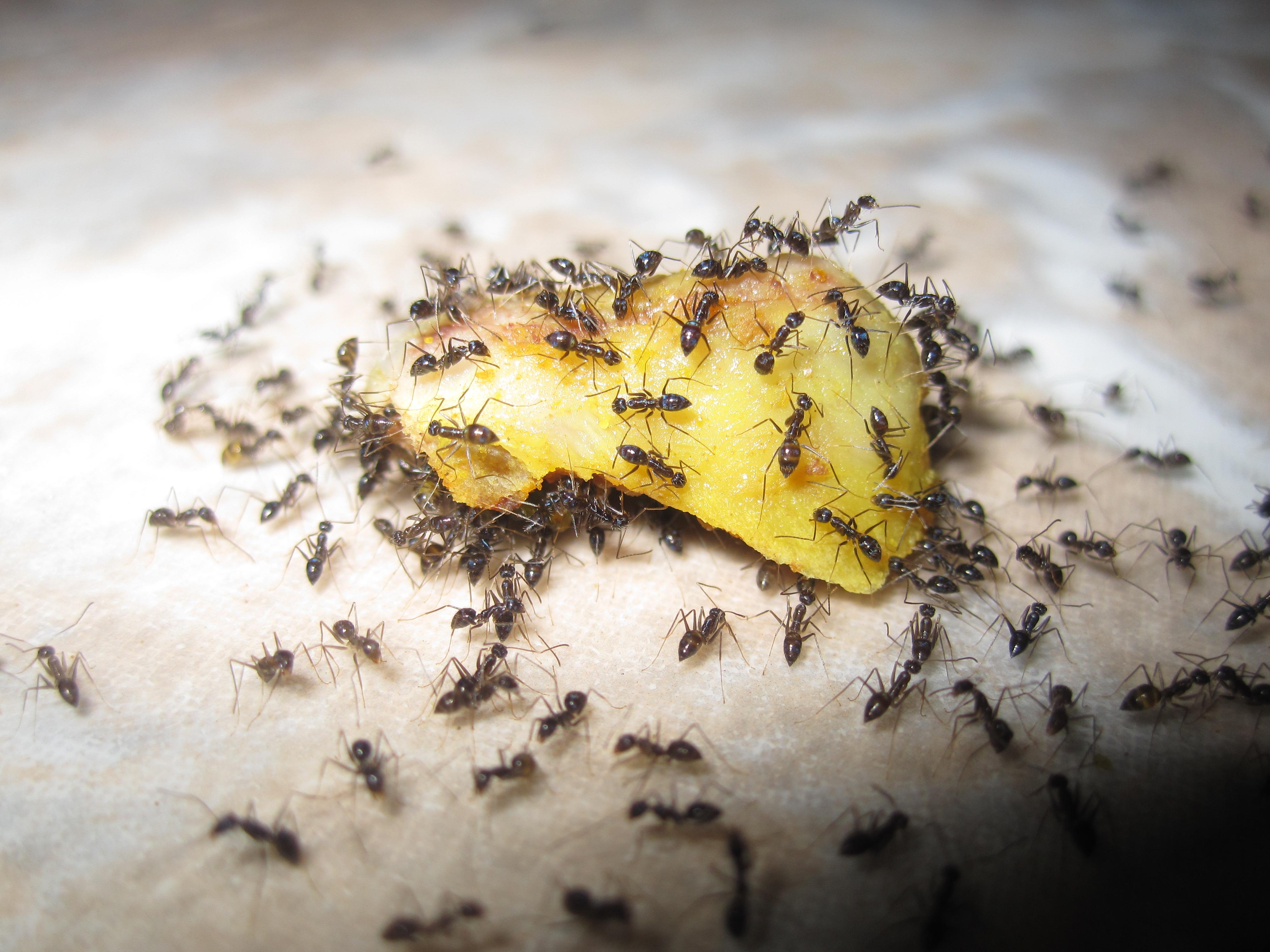
Ants foraging on food surfaces is one of the earliest signs of an indoor colony nearby. — Image: Wikimedia Commons, CC BY-SA
Insects
Carpenter Ants (Camponotus pennsylvanicus and related species)
Among the largest ants in Canada, carpenter ants are most active from April through September across Ontario, Quebec, and British Columbia. Unlike termites, they do not eat wood — they excavate it to form galleries for nesting. Signs of infestation include small piles of coarse sawdust (frass) near wooden structures, rustling sounds within walls, and sightings of large black or red-black ants, particularly at night.
Carpenter ants prefer wood that has been softened by moisture damage. Window frames, deck joists, and areas around plumbing penetrations are common nesting sites. A satellite colony indoors almost always indicates a parent colony nearby, often in a tree stump, rotting fence post, or structural wood exposed to weather.
Regional note: Carpenter ant infestations are most prevalent in British Columbia and the eastern provinces. The Pacific Dampwood Termite (Zootermopsis angusticollis) is sometimes confused with carpenter ants in coastal BC — termites have a thick waist and straight antennae, while carpenter ants have a narrow waist and elbowed antennae.
German Cockroach (Blattella germanica)
The German cockroach is the most widespread cockroach species in Canadian urban centres. It is predominantly found in multi-unit residential buildings, particularly in kitchen and bathroom areas where food residue and moisture are accessible. Adults are 13–16 mm long, pale brown with two dark stripes running lengthwise behind the head.
Infestations are identified by dark dropping deposits resembling ground pepper along cabinet edges, a faint musty odour in heavily infested areas, and egg cases (oothecae) approximately 8 mm long tucked into cracks. German cockroaches are almost exclusively indoor pests and rarely survive in outdoor conditions in Canadian climates.
Bed Bugs (Cimex lectularius)
Bed bugs are a concern in all Canadian provinces, with higher rates in urban centres such as Toronto, Vancouver, and Montreal. They are not associated with poor hygiene; they spread through travel, secondhand furniture, and shared laundry facilities. Adults are 4–5 mm long, oval-shaped, and reddish-brown — roughly the size of an apple seed.

Bed bug nymph feeding. CDC Public Health Image Library / Wikimedia Commons, public domain.
Signs of bed bug presence include small rust-coloured stains on mattress seams (from crushed bugs), tiny dark spots (excrement) along mattress edges and headboards, shed skins, and bite marks in linear or clustered patterns on exposed skin. Bites alone are not a reliable identifier since reactions vary significantly between individuals.
Cluster Flies (Pollenia rudis)
Cluster flies are a seasonal nuisance pest common across most of Canada. In autumn, large numbers enter homes through cracks around windows, soffits, and fascia boards to overwinter in wall voids and attic spaces. On warm winter days, they may become active and appear at south-facing windows. They are slightly larger and slower than house flies, with golden hairs on the thorax.
They pose no structural risk and do not reproduce indoors, but large accumulations in attic spaces can be difficult to eliminate without sealing all entry points before the overwintering season begins.
Rodents
House Mouse (Mus musculus)

House mouse (Mus musculus). Photo: 4028mdk09 / Wikimedia Commons, CC BY-SA 3.0.
House mice are the most common rodent pest in Canadian homes. They can enter through gaps as small as 6 mm — roughly the diameter of a pencil. Indicators include dark dropping deposits (3–6 mm, rod-shaped) along walls and in cabinets, gnaw marks on food packaging and structural materials, and greasy rub marks along frequently travelled routes near baseboards.
In colder provinces, mouse activity indoors spikes in September and October as temperatures drop. Basements, kitchen cabinets, and areas behind appliances are typical nesting locations.
Norway Rat (Rattus norvegicus)
Norway rats are primarily ground-dwelling and burrow near building foundations, garbage areas, and along waterways. They are larger than mice (adults typically 200–500 g) with blunt muzzles, small ears relative to body size, and tails shorter than the combined head-body length. Droppings are capsule-shaped and measure 18–20 mm.
Norway rats are more prevalent in urban areas and port cities. In Prairie cities such as Winnipeg and Edmonton, targeted rat prevention programs are maintained by municipalities. Alberta has historically maintained an active rat control zone along its eastern border.
Stinging Insects
Yellow Jacket Wasps (Vespula species)

Wasp nest constructed above a residential window. Photo: Kathy Jones / Wikimedia Commons, CC BY-SA.
Several Vespula species are common across Canada. Yellow jackets build papery nests in ground cavities, wall voids, attic spaces, and under eaves. Colonies grow throughout summer and reach peak size — sometimes numbering several thousand workers — in August and September. During this period, workers become more aggressive, particularly around food sources.
Nests found within wall voids or ceiling spaces present a greater removal challenge and a higher sting risk than exposed aerial nests. Unlike honeybees, yellow jackets can sting multiple times.
How to Document a Pest Sighting
Accurate identification is the first step toward selecting an appropriate response. When noting a pest sighting:
- Photograph the pest if safe to do so, alongside a common object for scale reference.
- Note the location in the home (room, surface, time of day).
- Record whether droppings, nests, frass, or damage are visible nearby.
- Note approximate numbers and how frequently the pest has been observed.
This information is useful both for self-assessment and for any professional who may be consulted. Many provincial health units maintain pest identification resources and, in some cases, specimen submission services.